

Matladu — Telugu for “talk”

Speak everyday Telugu in 60 days.

Not the script. Not the grammar tables. The Telugu you need at a tea stall, in an auto, at your girlfriend’s grandmother’s lunch table — and an app that tracks every phrase you meet so it can hand it back the day before you would have lost it.

Start learning

The first seven chapters are free — no card, just a Google sign-in, and your progress is there on whichever device you open next. Or start in the library: nine shelves and seven games, no account, no email address.

Roman Telugu, alwaysNative audio on every lineEvery phrase on its own scheduleSeven games, nine shelves

Tap any word

I want tea.

.

Every word in the app opens like this — including the ones inside the word you just opened.

Now change what you want. The frame does not move.

Varun arrives at Hyderabad airport with his suitcase, autos waiting at the kerb

“From today, only Telugu between us.”

Rahul, outside the airport. Day one.

The premise

You play Varun. You have a deadline.

He lands in Hyderabad from Chennai for a job. He and Niharika are serious — and her family has never met him. English will get him through the airport. It will not get him through lunch.

Day 30

The parents

Lakshmi Aunty and Prakash garu. They understand some English — that is exactly the problem. Falling back to it costs you.

Day 60

Bamma

Sitamma. Telugu only, no English rung on the ladder, and the one whose verdict actually decides. Everything before this is preparation.

Every phrase you learn is a phrase you are going to need in front of someone who is waiting for an answer.

Week one — Arrival

The story is the syllabus.

Fourteen chapters get you from the airport to the day family prep begins. You do not study a topic and then look for a use for it. You walk into a situation and need the words.

Varun and Rahul outside Hyderabad airport on day one, making the pact to speak only Telugu
Day 1Story beat

Landing

Rahul meets Varun outside the airport and makes the pact that starts everything: from today, only Telugu between us. You learn to say who you are.

I am Varun.

Nenu Varun.

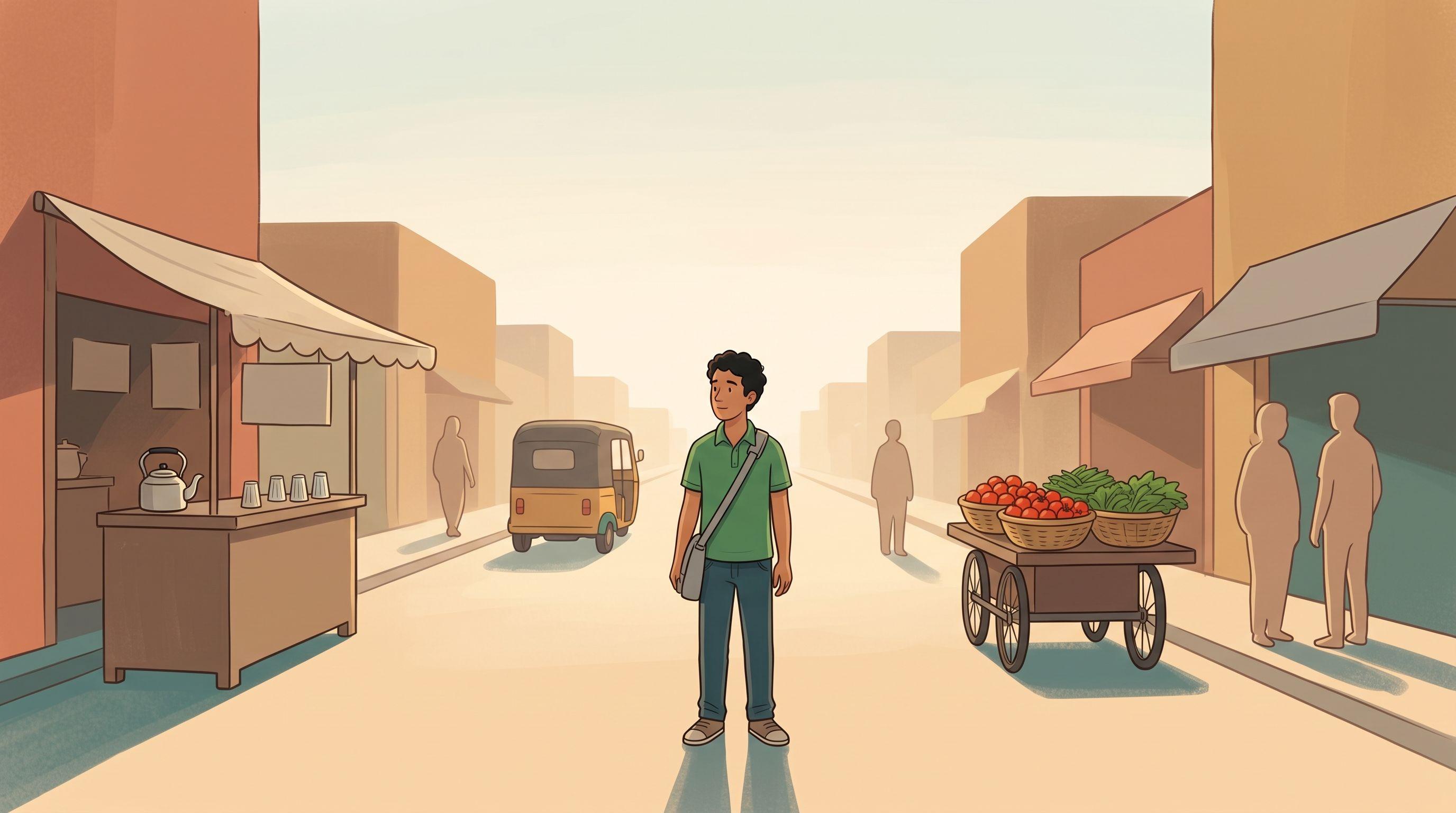
Varun negotiating an auto fare with Basha on a Hyderabad street, asking how much in Telugu
Day 3

First auto

Basha's auto, a fare to argue about, and a destination to name. Where, how much, stop here — the first Telugu that has to work on the first try.

How much to Ameerpet?

Ameerpet ki entha?

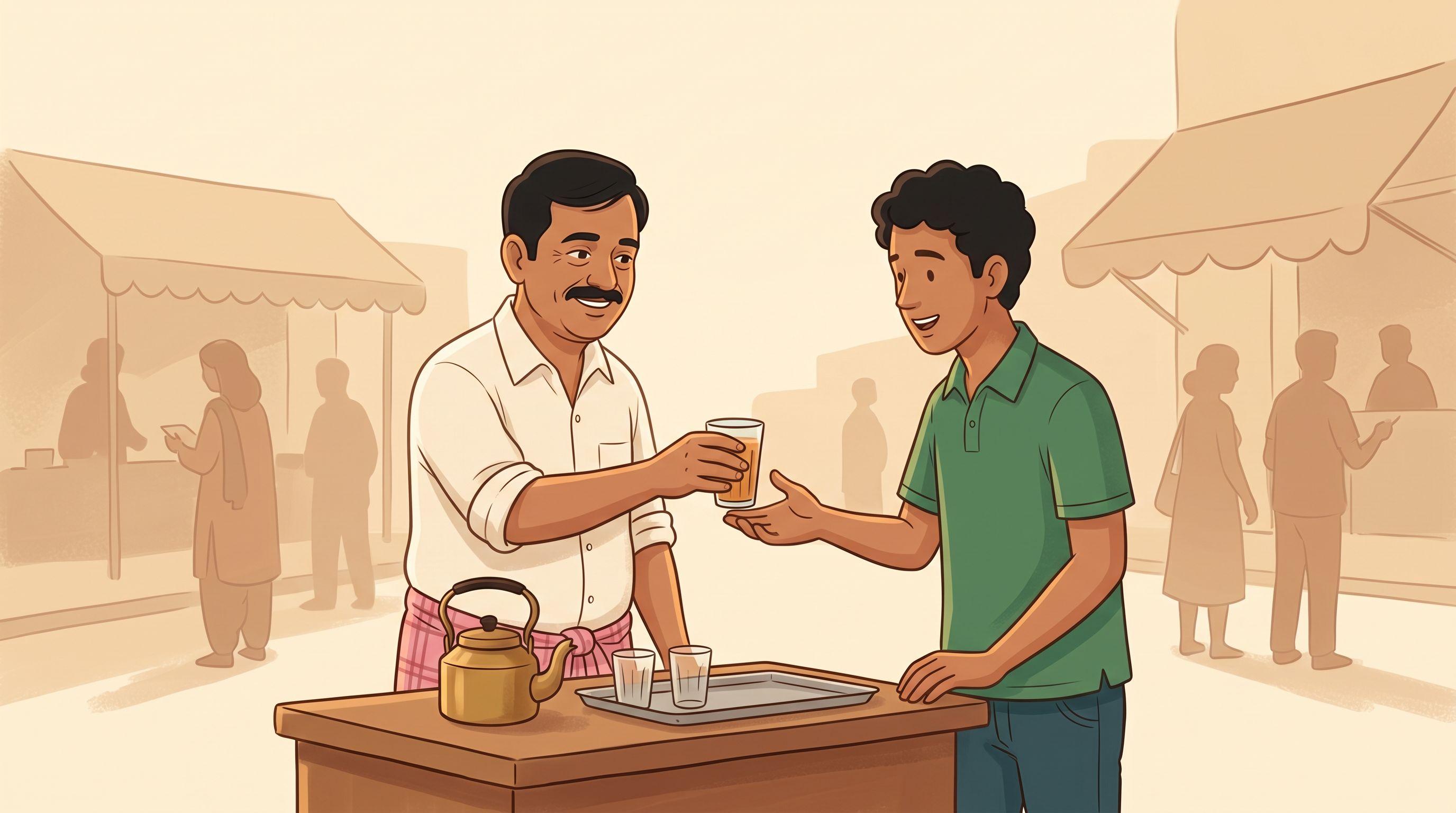
Raju pouring chai at his tea stall while Varun orders in Telugu
Day 4

Chai at Raju's

Raju pours, asks what you want, and waits. This is where you meet the pattern you will reuse for the next sixty days.

I want tea.

Naaku chai kaavaali.
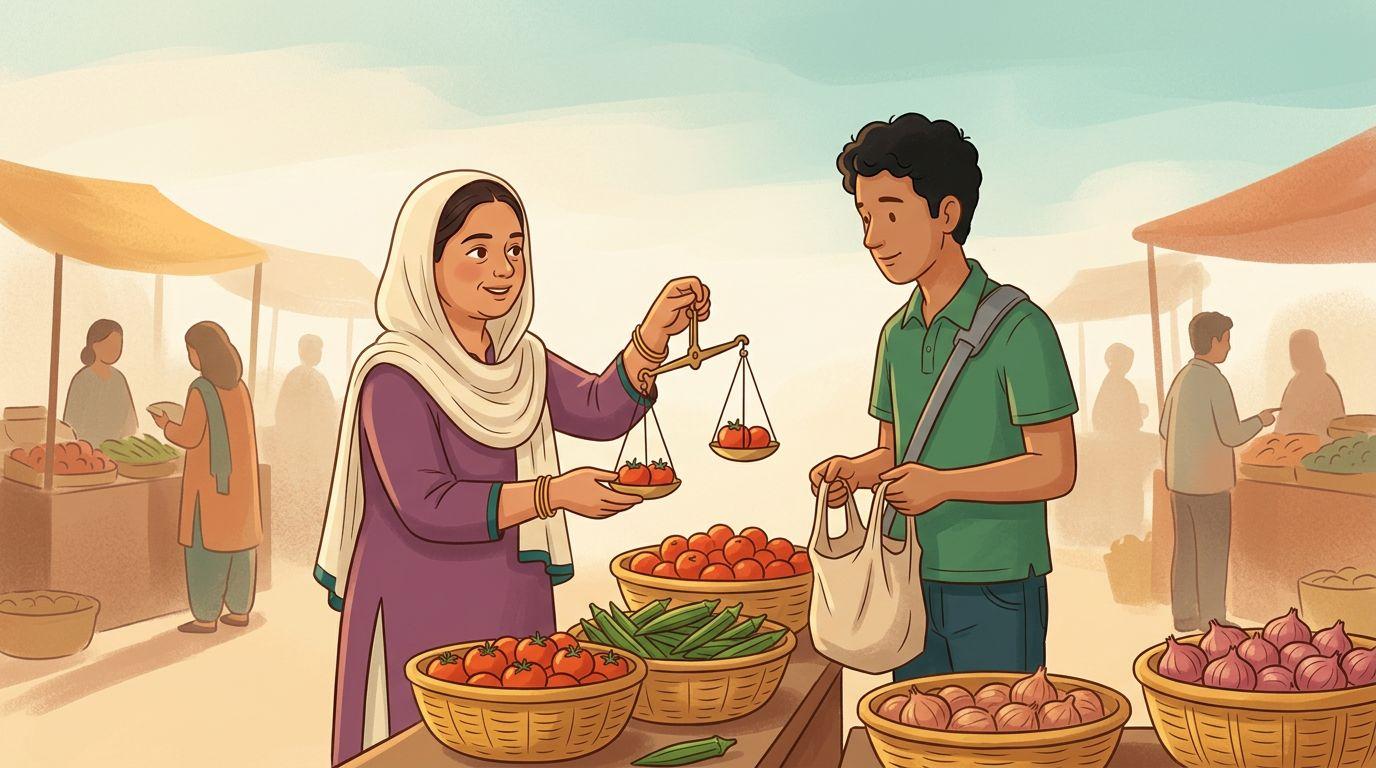
Salma weighing vegetables at her market stall while Varun bargains over the price in Telugu
Day 5

Salma's market

Numbers, prices, and the small ritual of bargaining. Salma is kind, but she is not going to slow down for you.

That is too much.

Chaala ekkuva.
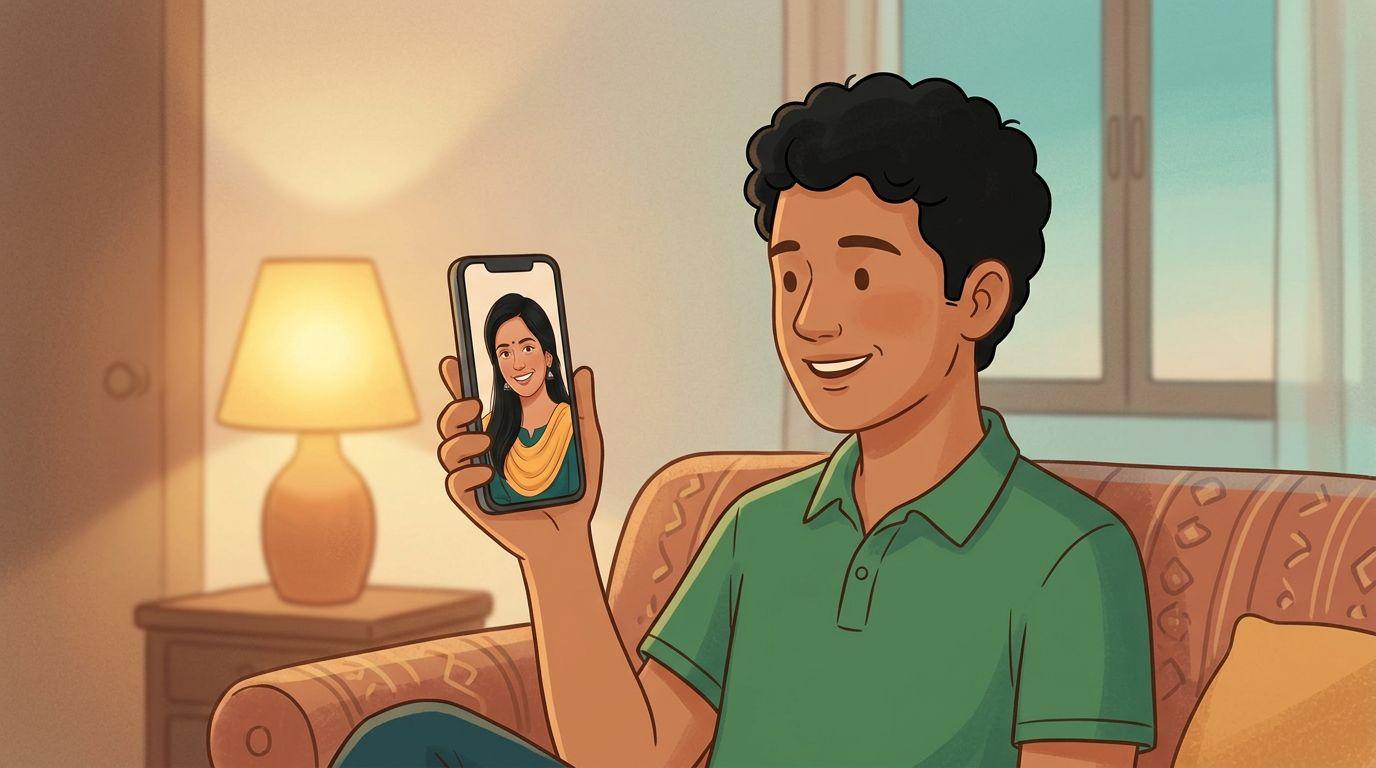
Varun on a video call with Niharika, answering her questions in Telugu at the end of week one
Day 7Story beat

Niharika calls

The week-one test. Niharika video-calls and everything you learned has to come back at once — plus one stranger you have never met.

What are you doing?

Em chestunnavu?

Week two — Making it yours

The same people, harder conversations.

You already know Basha and Raju. Now they expect more of you — and so does everyone else.
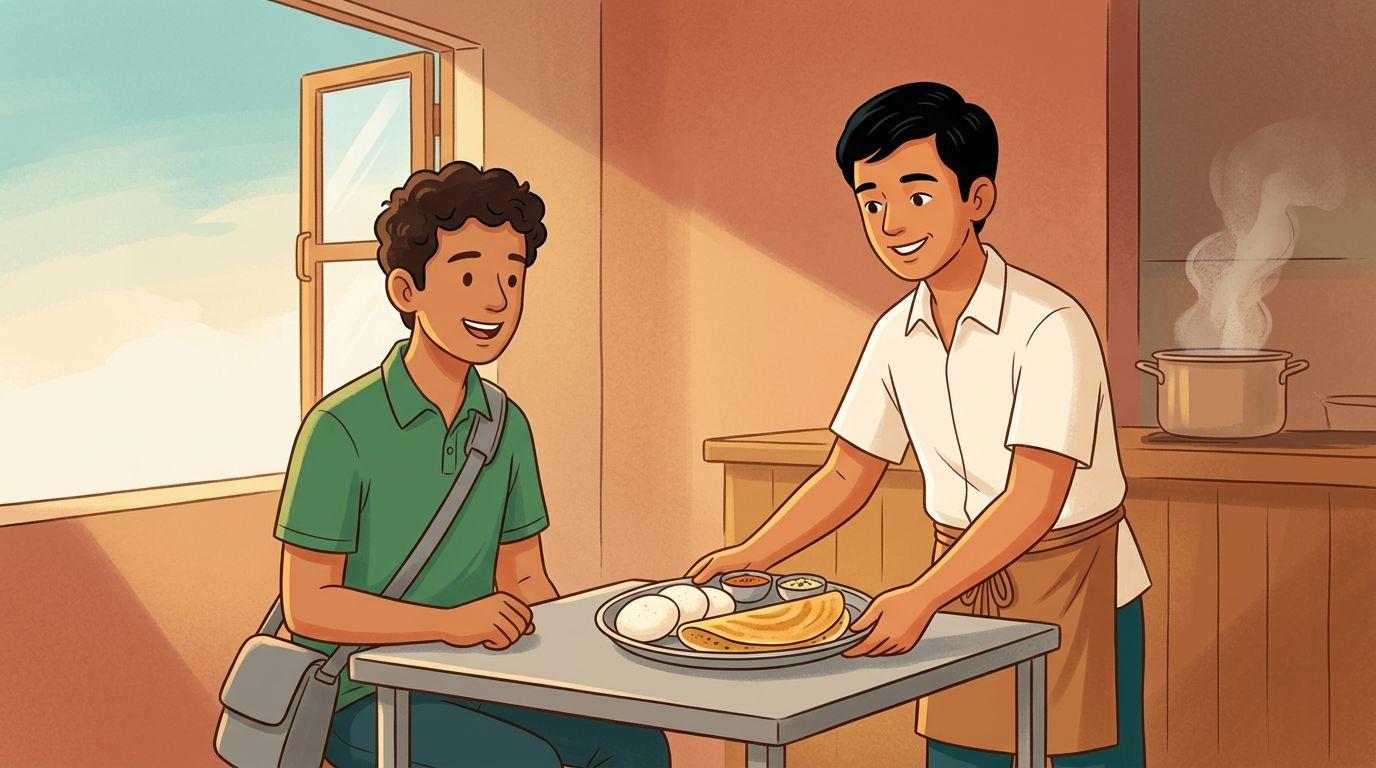
Venu serving dosas at his tiffin centre while Varun orders breakfast in Telugu
Day 8

Tiffin at Venu's

Breakfast, ordered properly. Venu is proud of the dosas and will absolutely notice if you order like a tourist.

One dosa, please.

Oka dosa ivvandi.
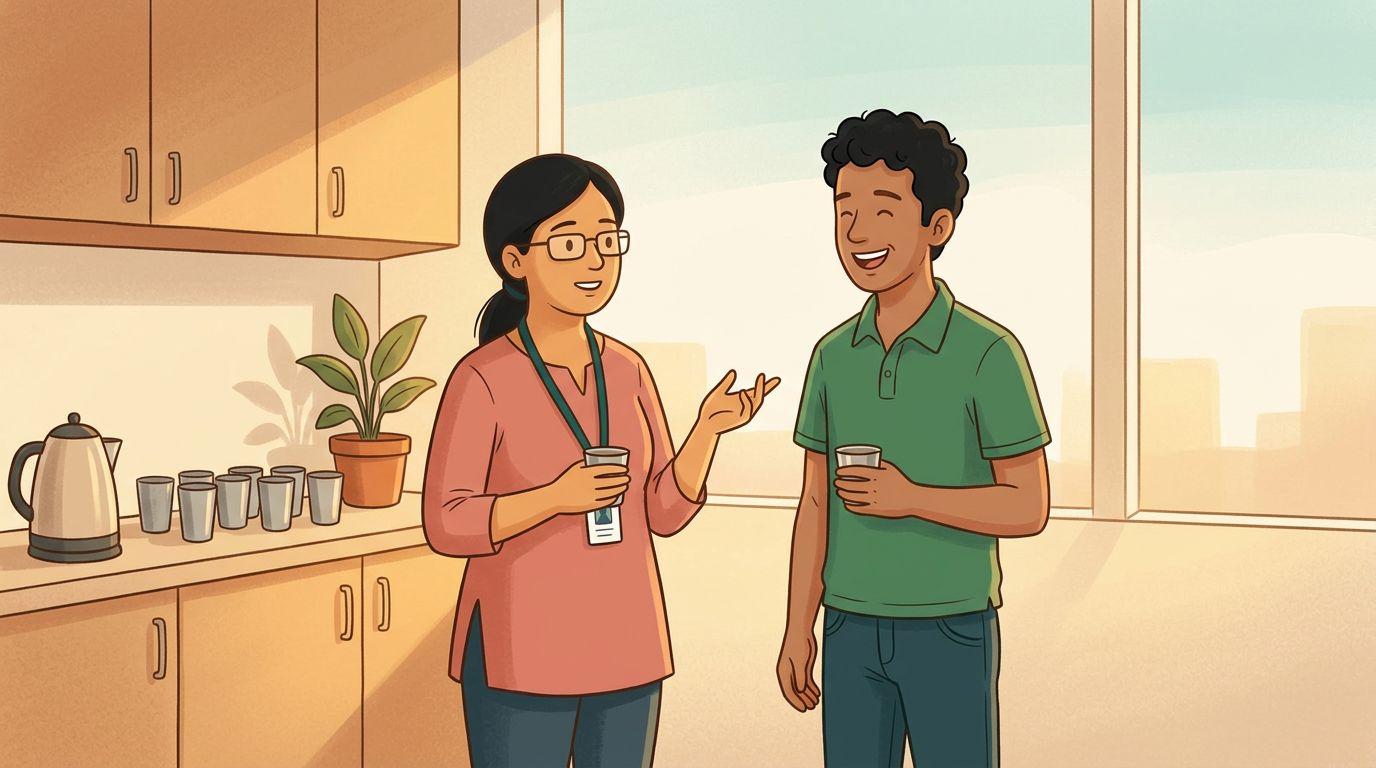
Divya and Joshua making small talk with Varun in the office pantry, in Telugu
Day 10

Office pantry

Divya asks what you are up to; Joshua is one lesson behind you and delighted about it. Small talk is a skill and this is where you get it.

I like it.

Naaku nachindi.
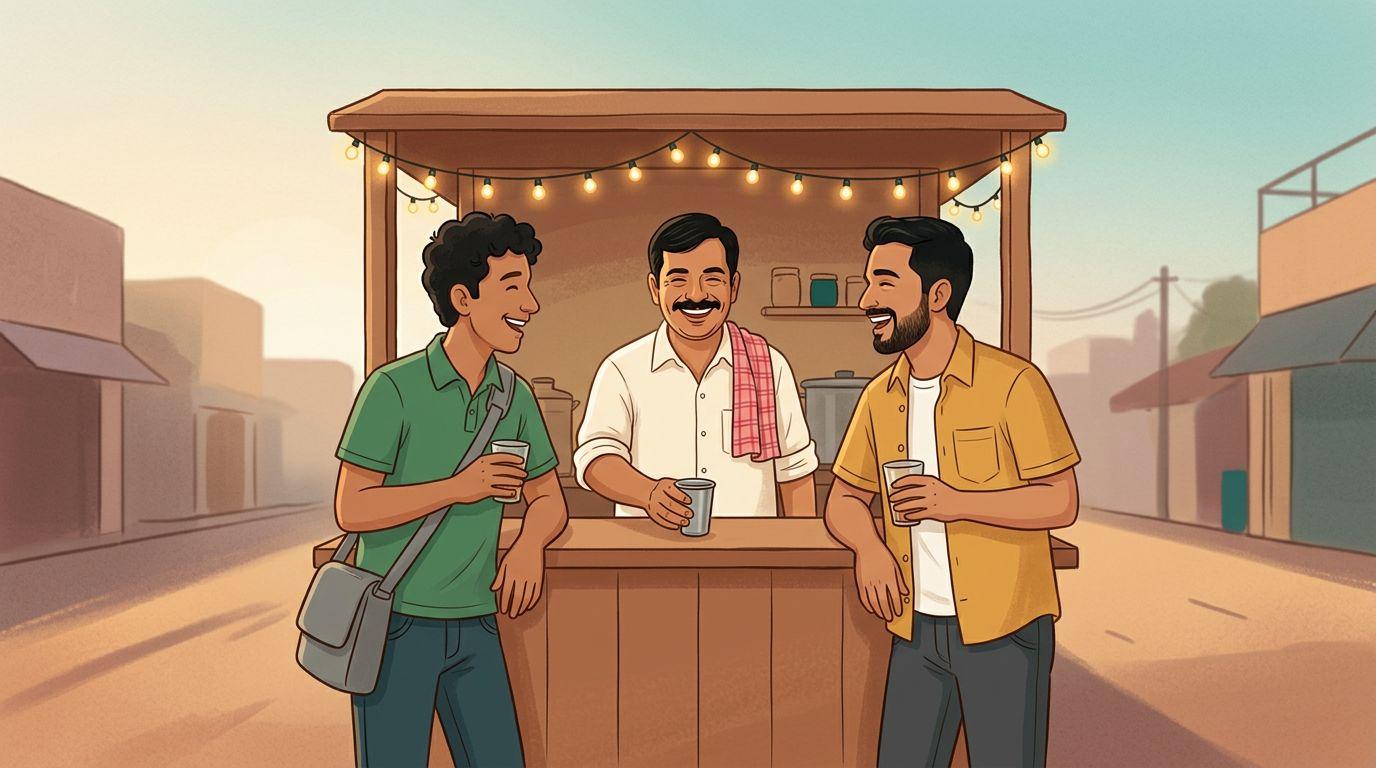
Rahul and Varun over a second glass of chai at Raju's stall in the evening
Day 12

Evening at Raju's

Rahul, a second chai, and the whole vocabulary of agreeing, disagreeing, and hedging. Yes, no, maybe, it's fine.

It's fine.

Parledu.
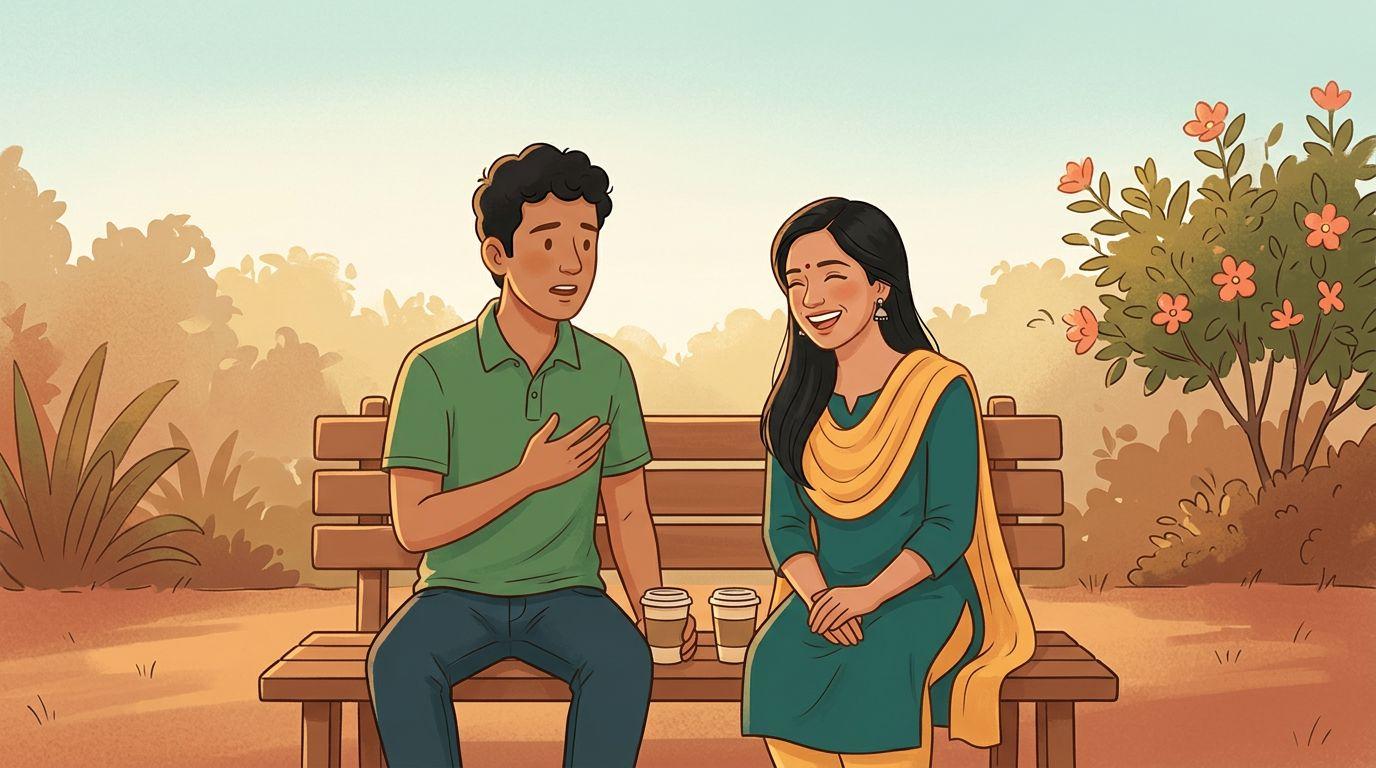
Varun and Niharika out together on their first conversation held entirely in Telugu
Day 13Story beat

Niharika visits

The first full-Telugu date. It goes better than it should — and then she mentions her parents. The clock starts.

Shall we go?

Veldhama?
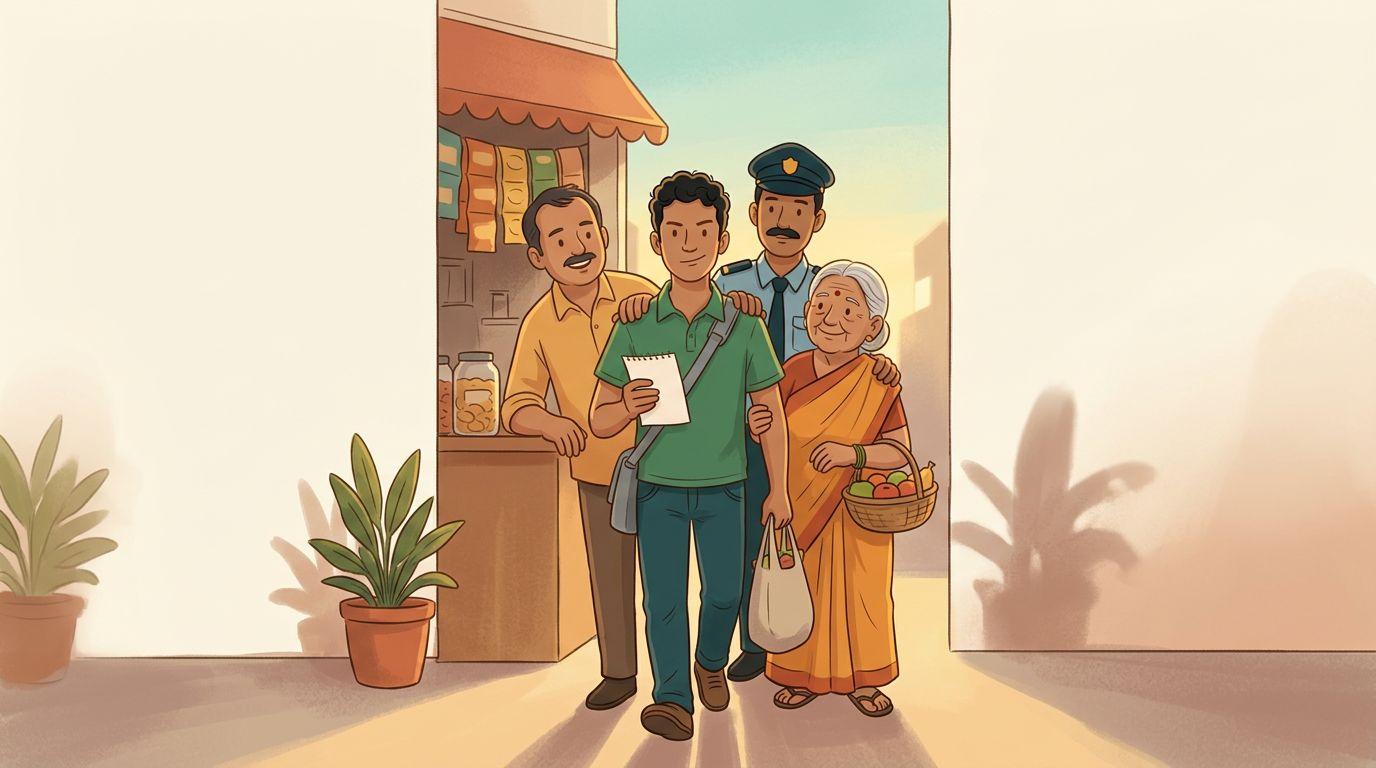
Varun running three errands with three strangers in one afternoon while Rahul watches
Day 14Story beat

The errand gauntlet

Three strangers, three errands, no rehearsal. Rahul watches. Then he tells you family prep starts now.

Then, the long game

Day 30, her parents. Day 60, Bamma — who speaks no English, and whose word is the one that counts.

Sixty chapters, sixty days of Varun’s life. One a day finishes the story on time. Slower is never punished — day 14 means your day 14.


How it works

Meaning first. Rules never.

You are never asked to learn a rule before you use a sentence. Patterns surface because you meet them five times in five situations — not because a lesson announced them.

The scene comes first

A person, a place, a reason to speak. You hear natural Telugu, see the English meaning, and understand before anything is explained. Explanations exist only when they help.

Then the help gets removed

You start with English, Roman Telugu, audio, and the picture. Rung by rung, those get taken away until the situation alone is enough. Understanding and speaking are tracked as separate skills, because they are.

Then the app keeps count

Every phrase you meet goes onto two schedules of its own, and comes back right before you would have lost it — sometimes as a review, sometimes as a message from the person who said it to you. Difficult phrases return sooner. Nothing is silently dropped.

The scaffolding, and how it disappears

Every phrase climbs this ladder on its own schedule. Succeed, and it moves up a rung. Fail, and it drops back down.

  1. 1Exposure

    English, Roman Telugu, the scene, the audio

    Meaning and sound

  2. 2Recognition

    Telugu audio → what did that mean?

    Understanding

  3. 3Guided recall

    English, with the words shuffled

    Building the sentence

  4. 4Cued recall

    English, and the first word only

    Retrieval with a hand

  5. 5Free recall

    English. That's it.

    Production

  6. 6In the scene

    A person, a situation, no prompt

    Saying the right thing

A phrase only counts as known once you have produced it from free recall on two different days. Tapping through a conversation is exposure — and exposure is worth nothing on the ledger.

The memory engine

A book can hold the phrases. It cannot tell which ones you are losing.

That is the whole reason this is an app. Every phrase you meet gets its own arithmetic, run against your own answers, every day, for sixty days — so what you open tomorrow is not the next page, it is the handful of things you personally are about to forget.

Two ledgers per phrase, not one

Understanding a phrase and producing it are different skills, so they are scheduled apart. Production comes back sooner and its gaps widen more slowly, because it is the harder of the two. You can be fluent at hearing Naaku chai kaavaali weeks before you can say it cold, and the app knows which of those two you are.

The interval belongs to the phrase

Every answer moves that one phrase's own schedule and nothing else's. Answer instantly and the gap stretches. Miss it and the gap collapses to a quarter of what it was and the phrase drops a rung on the ladder — a phrase you had held for a month comes back in about a week. Nothing is ever scheduled more than 180 days out, so nothing quietly falls off the edge of the list.

Claiming it was easy gets tested

About one time in four, grading yourself as instant stops the review and makes you produce the phrase cold instead. If those two disagree, every interval tightens for the next fortnight until they agree again. Self-assessment is the weak point of every review app and this is the correction for it.

Known has a definition

A phrase counts as known once you have produced it from free recall, unaided, on two different days. Not two sessions on the same evening — two days. Tapping through a conversation is exposure, and exposure is worth nothing on the ledger.

None of that is content. It is arithmetic, run against your answers, per phrase, every day — and it is the part you are actually paying for.

However you learn

Nine shelves. Seven games. No account.

The story is the spine, not the walls. Some people work through the chapters and never open a shelf; some live in the games and the dictionary. All of this is open to anyone who turns up — no sign-in, no email address, nothing to cancel.

Themes

Practical vocabulary in small themed sets — the things you need this week.

Words

All 597 of them, searchable from English or Roman Telugu, either direction.

How to say it

Real moments, indexed by moment: ordering, greeting, bargaining, asking for help.

Patterns

Reusable sentence shapes. Swap the word, keep the shape, say a hundred new things.

Guides

Reference reading for the bits of spoken Telugu that only click when someone explains them.

People

The whole cast, and how each of them speaks to you differently.

Scenarios

Every day of the story, open to replay — or to read ahead, if that is how you like to work.

Games

Seven of them, dealt from words you have actually met.

Word Album

Every word you meet becomes a card, and the card levels up as you keep getting it right.

Seven games, and each one leans on something different

Every round is dealt from words you have actually met, so none of it is filler — and every round ends on a doorway: the word you missed links straight back into the library.

  • Picture MatchWord to picture and back — the classic warm-up.Pictures
  • Sound MatchHear a word, catch it among four that sound almost the same.Ears
  • Opposites SprintFlip each word to its opposite before it flips you.Meanings
  • Odd One OutThree words belong together. Spot the stranger.Word groups
  • Suffix BuilderBend a verb through time by picking the right ending.Word forms
  • What Would You Say?Right phrase, right person — friend or elder?Register
  • Memory PairsFlip and match each word with its other face.Recall

Play one now, without signing in →

One connected world

Your people in Hyderabad.

Eight people you actually get to know — and who decide how you speak. Rahul gets nuvvu. Raju gets meeru. Telugu makes you choose, and the choice is a person, not a grammar rule.

Rahul, the old friend settled in Hyderabad who made the only-Telugu pact

Rahul

nuvvu

Old friend, settled here

Made the pact. Talks to you like a friend — nuvvu, fast, no allowances.

Niharika, the reason Varun is learning Telugu

Niharika

nuvvu

The reason for all of this

Warm, quick, teasing. Corrects you gently and notices when you improve.

Basha, the auto driver who speaks in short functional Telugu

Basha

meeru

Auto driver

Short, functional sentences. Fares, shortcuts, sare.

Raju, the tea-stall owner who repeats prices until you have them

Raju

meeru

Tea-stall owner

Loud and friendly. Repeats prices and quantities until you get them.

Salma, the market vendor who quotes per kilo and enjoys a bargain

Salma

meeru

Market vendor

Sharp but kind. Calls you anna, quotes per kilo, enjoys a bargain.

Divya, the colleague whose office Telugu is sprinkled with English

Divya

meeru

Colleague

Friendly-neutral office Telugu, sprinkled with English.

Joshua, the colleague who is always one lesson behind you

Joshua

nuvvu

Colleague, fellow learner

Always one lesson behind you. His mistakes are the ones you were about to make.

Venu, the tiffin-centre server who speaks in polite service formulas

Venu

meeru

Tiffin-centre server

Polite service formulas. Randi. Meeku em kaavaali?

Every word is a doorway, not a dictionary entry.

Tap any Roman Telugu word — in a scene, in a game, in a review — and you land on its own page. What it means, and what it is literally doing in the sentence. Its opposite: takkuva sits under ekkuva, akkada under ikkada. Where it falls on a scale. The words it gets confused with, and the difference. Every form it bends into — 597 words carry 803 forms between them. And every other place in the story it is spoken, by whom, to whom.

Tap a person to see every scene they are in. Tap a scene to see its people and its phrases. Wander as deep as you like, or ignore all of it: the guided path always tells you what to do next.

What Matladu will not do

Nothing here is designed to keep you here.

Every mechanic that exists to farm your attention rather than teach you Telugu has been left out on purpose.

No subscription

One payment, once. Nothing renews, nothing is kept on file, and there is nothing to remember to cancel.

No hearts or lives

A mistake costs you nothing but an earlier review.

No leaderboard

You are not competing with strangers for a language.

No XP, no coins, no shop

The only score is what you can say, and to whom.

No streak guilt

Miss a week. The story recaps and waits for you.

No Telugu script

It is a different skill. It is not the one you came for.

No wall around the language

The whole library — all 597 words, every pattern, every scene, all seven games — is open without an account, and stays that way. Paying unlocks the guided path and the memory engine, never the Telugu itself.

No tracking, no ads

Signing in tells us the email, name and picture on your Google account, and we keep your learning progress so it follows you between devices. Nothing else, and none of it sold or handed to an ad network.

The price

One payment. Then it is yours.

The library costs nothing and asks for nothing — no account, no email. The first week costs nothing and asks only that you sign in. After that, the rest of the sixty days is a single payment: roughly four hours of a Telugu tutor, for an app that works on you for sixty.

Free, no card

Free

  • The whole library — all 597 words, every pattern, every scene, all seven games, open without an account
  • Chapters 1 through 7, the first week of the story, with a Google sign-in
  • Native audio on everything
  • Your progress saved to your account, on every device you sign in from
Open the library

The whole app, once

$49once

One payment. No renewal, nothing to cancel.

  • The memory engine across all sixty chapters — every phrase on its own two schedules, for as long as you keep turning up
  • Chapters 8 through 60 — the parents, Bamma, and the day it counts
  • The challenge chapters, where nothing is prompted and nobody slows down for you
  • Every correction and improvement we make to the sixty chapters, forever
Start chapter 1 free

30 days, no questions asked, full refund.

You do not have to justify it and you will not be asked to. Read the refund policy.

Questions

The things people ask first.

Is this a course?

No, and the difference is the entire product. A course is a fixed sequence of content — the same pages, in the same order, for everybody who bought it. If that is what you wanted, take it for nothing: the library already holds every word, every sentence pattern, every scene and all seven games, with no account and no email address. What you pay for is the app running on top of that. It tracks every phrase you have met on two separate schedules, and each morning it works out which handful you personally are about to lose. A course hands everyone the same page. This hands you the ones you specifically are about to lose.

Why not just read a phrasebook or a PDF?

Because meeting a phrase was never the hard part — still having it three weeks later is. A phrasebook can hold five hundred phrases and has no way of knowing which ones have gone. You have to guess, and people guess badly: they re-read what already feels comfortable, which is exactly the material they did not need to review. Matladu meets you at the phrases you are actually failing. Recognition and production are scheduled apart, intervals stretch when you answer fast and collapse to a quarter when you miss, and a claim that something was easy occasionally gets checked. If you want the phrases without any of that, read the library for free and do not pay us. That is a real option and we would rather say so.

What if I don't learn well from a story?

Then use one of the other eight shelves. The story is the spine, not the walls. The library is nine separate ways into the same connected world — themed vocabulary sets, a searchable dictionary of 597 words, sentence patterns, situations indexed by moment, reference guides, the cast, every scenario open to replay, seven games, and a word album where each word you meet becomes a card that levels up. Some people work through the story and never open a shelf. Some live in the games and the dictionary. The guided path always tells you what to do next if you want to be told, and never insists.

What are the games actually for?

Seven of them, and each one leans on a different sense. Sound Match works your ears — one word among four that sound almost identical. Odd One Out works word groups. Suffix Builder works endings, bending a verb through time. What Would You Say? works register, which is the thing English never made you think about: right phrase, wrong person, and you have been rude. Memory Pairs works plain recall, Opposites Sprint works meanings, Picture Match works pictures. Every round is dealt from words you have actually met, so none of it is filler, and every round ends on a doorway — the word you missed links straight into the rest of the library. All seven are open without an account.

Do I need to sign in?

To look around, no. To play, yes — and that is the whole of the boundary. The library is open to anyone and stays that way: every word, every sentence pattern, every scene, the games, the word of the day, with no account and no email address. Opening a chapter is where it changes. The first seven cost nothing and ask for no card, but they do ask you to sign in with Google first. What that sign-in hands over is the email address, name and picture on your Google account, and nothing else. From then on your progress is kept with that account, so the chapter you finished on your laptop is waiting on your phone, and a wiped browser costs you nothing.

What does it cost?

Forty-nine dollars, once. Nine hundred and ninety-nine rupees in India. That buys the memory engine running across all sixty chapters, chapters 8 through 60 themselves, the challenge chapters, and every correction we make to the sixty afterwards. Set against a Telugu tutor at roughly four hours' worth, for something that works on you for sixty days. There is no second payment and no renewal. The word lifetime is doing literal work there, not marketing work.

Is it a subscription?

No. There is no recurring charge anywhere in Matladu — no monthly plan, no annual plan, nothing to cancel, and no card kept on file for a renewal you forgot about. You pay once. If sixty days turns into six months because life happened, that costs you nothing extra.

What if it doesn't work for me?

Thirty days, no questions asked, full refund. You do not have to justify it and you will not be asked to. Better still: play the first seven chapters before you pay anything at all. That is about seventy minutes and it ends on a story beat, which is enough to know whether this method fits the way you learn.

What do you do with my data?

If you have only used the library, nothing at all — it never asks who you are. Signing in to play hands us what Google hands us: your email address, your name, and your profile picture. After that we store your learning progress: which chapters you have done, which phrases you have produced, and when each one is next due, because carrying it between your devices is impossible without them. Buying adds one more thing, a payment reference. No advertising, no tracking across other sites, nothing sold to anyone. The privacy policy is short because there is not much to describe.

Do I have to learn the Telugu script?

Never. Everything is written in Roman Telugu and English — Naaku chai kaavaali, not the script. This is a spoken-language product, and reading the script is a different skill that would slow down the one you actually came for.

Is this a grammar course?

No. You are never asked to learn a rule before you use a sentence. Patterns like Naaku ___ kaavaali surface because you meet them five times in five situations, not because a lesson announced them. Register — whether you say nuvvu or meeru — is taught as social context: who you are talking to, not which conjugation table applies.

What is actually happening under the hood?

Every phrase you meet is tracked on two separate ledgers: can you understand it when you hear it, and can you produce it from an English thought. Those are different skills, so they are scheduled apart — production comes back sooner and its gaps widen more slowly, because it is the harder one. Each answer moves that phrase's own interval and nothing else's: answer instantly and it stretches, miss it and it collapses to a quarter of what it was and drops a rung on the ladder. Nothing is ever scheduled beyond 180 days, so nothing silently leaves the list. About one time in four, grading yourself as instant triggers a surprise production check, and if your self-assessment and your actual recall disagree, every interval tightens for a fortnight. Words ride a lighter schedule of their own — one day, three, seven, fourteen, and back in six hours if you miss — woven in among the phrase reviews so that a backlog of one never buries the other. A phrase counts as known only after free-recall production, unaided, on two different days. Tapping through a conversation is exposure, and exposure is worth nothing on the ledger.

What does 'everything is tappable' mean?

Any Roman Telugu word, anywhere in the app, opens its own page — and that page is not a dictionary entry, it is a neighbourhood. What the word means and what it is literally doing in the sentence. Its opposite: takkuva sits under ekkuva, akkada under ikkada. Where it falls on a scale, when it belongs to one. The words it gets confused with, and the difference. Every form it bends into — 597 words carry 803 forms between them. The patterns it belongs to, and every other place in the story it is spoken, by whom and to whom. Tap a person to see every scene they are in. Tap a scene to see its people and its phrases. You can wander as deep as you like, or ignore all of it — the guided path always tells you what to do next.

Is there a streak, hearts, XP, a leaderboard?

No hearts, no lives, no leaderboard, no currency, no shop. Mistakes cost you nothing except a phrase coming back sooner. The only thing measured is capability — what you can now say to whom — and the only celebration is a real one: you can now order food politely, you can now ask where something is.

How long is a session?

About ten minutes: a few reviews that are due, one illustrated scene, four or five new phrases, and a short conversation that uses them. One chapter a day finishes the story in sixty days. Slower is never punished — Day 14 means your day 14, not the calendar's.

Who made this, and why?

It was built by someone with the same deadline as Varun. The story is a game, but the reason for it is not: family, a language they don't share with you, and a real date on the calendar. Everything in here exists because it was needed first.

Writing

The thinking behind the syllabus.

Why script-first teaching loses people, what the other Telugu apps actually teach, and which words a beginner needs first — written by the person who wrote the sixty chapters.

Your auto is waiting.

Day 1 is the airport, the pact, and your name in Telugu. It takes about ten minutes, and a Google sign-in is the only thing standing in front of it.

Start day 1

Chapters 1–7 are free: sign in with Google, no card. Or open the library, which asks for nothing at all.